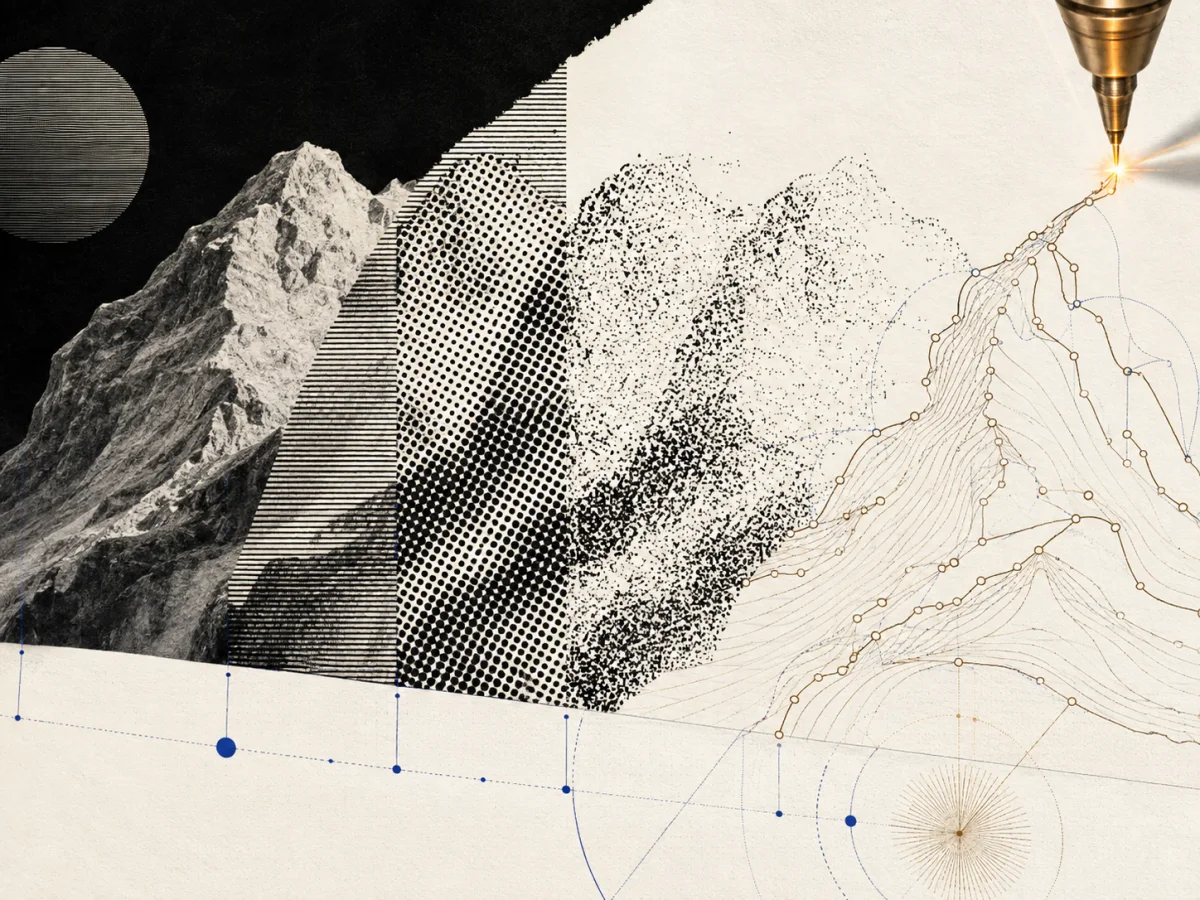
Core question: how can finite physical output states preserve the visual structure of a continuous image?
Wu, Inoue, and Hara use Neugebauer models, error diffusion, and sparse candidate sets for colour halftoning. This note examines their relevance to discrete output states in laser image jobs and the material mappings that must be rebuilt when moving from image-domain comparisons to calibration coupons.
01 / The problem is not simply black or white - it is where the error goes
Halftoning converts continuous tone into a spatial arrangement of limited output states. In error diffusion, the current pixel is quantized and the residual error is distributed to unprocessed neighbours. Each mark remains discrete, while the spatial pattern produces an intermediate visual tone.
Laser image processing has a similar structure: the machine ultimately executes dots, scan lines, or path segments, while the user perceives overall tone, edges, and texture. The real design problem is the mapping between digital pixels, discrete process states, and material response.
02 / The Neugebauer model provides a language of probabilistic mixtures
The paper first rewrites a grayscale value as a convex combination of black and white, then extends the formulation to combinations of basic colours in RGB space. Because the coefficients are non-negative and sum to one, they can be interpreted as spatial occurrence probabilities.
The authors then combine the model with the Minimal Brightness Variation Criterion (MBVC), restricting candidate colours to a local tetrahedron and producing a sparse Neugebauer representation. Their experiments report better preservation of basic-colour occurrence probabilities than conventional colour error diffusion, with less halftone noise than the compared MBVC method.
03 / For laser use, the output states must be defined again
Printing primaries are not laser states. For monochrome engraving, a state might mean on/off exposure, a finite power level, or pulse density. For colour marking on metals, wavelength, frequency, pulse width, focus, and surface condition also matter. That mapping must be established for a specific source, motion system, and material.
The paper therefore belongs in the candidate-algorithm layer, not in a material preset. A responsible workflow first compares discretization results on standard images, then validates pitch, spot overlap, and thermal accumulation on calibration coupons, and only then considers a device-specific process strategy.
- Reusable: probability constraints, sparse candidate sets, and the mathematics of residual propagation.
- Must be rebuilt: output states, material response, beam-spot model, and machine-level evaluation metrics.
- Current conclusion: suitable for a software prototype; without machine data, no claim about real engraving quality is justified.
- 01 Image input Colour space and resolution
- 02 Candidate algorithm Discretization and error diffusion
- 03 Device mapping Source, spot and material states
- 04 Coupon measurements Visual error and process quality
04 / Direct implications for product architecture
Image processing should not emit a vendor-specific device command directly. A more robust architecture first produces a device-independent image job that records the source image, colour space, discretization method, parameters, random seed, resolution, and output pattern. A device adapter then compiles that representation for a particular source and material capability.
The benefit is reproducibility, not abstraction for its own sake. The same input can be replayed across algorithms for A/B comparison, and later calibrated against machine results without rewriting the canvas or project-file layer.
PRIMARY SOURCE DOSSIER
- Paper Title
- Neugebauer Models for Color Error Diffusion Halftoning
- Authors
- Kaiming Wu, Kohei Inoue, Kenji Hara
- Journal
- Journal of Imaging, 2020, 6(4), 23
- Published
- 17 April 2020
- DOI
- 10.3390/jimaging6040023
- Licence
- Creative Commons Attribution 4.0 International (CC BY 4.0)
- Original URL
- Open original paper ↗