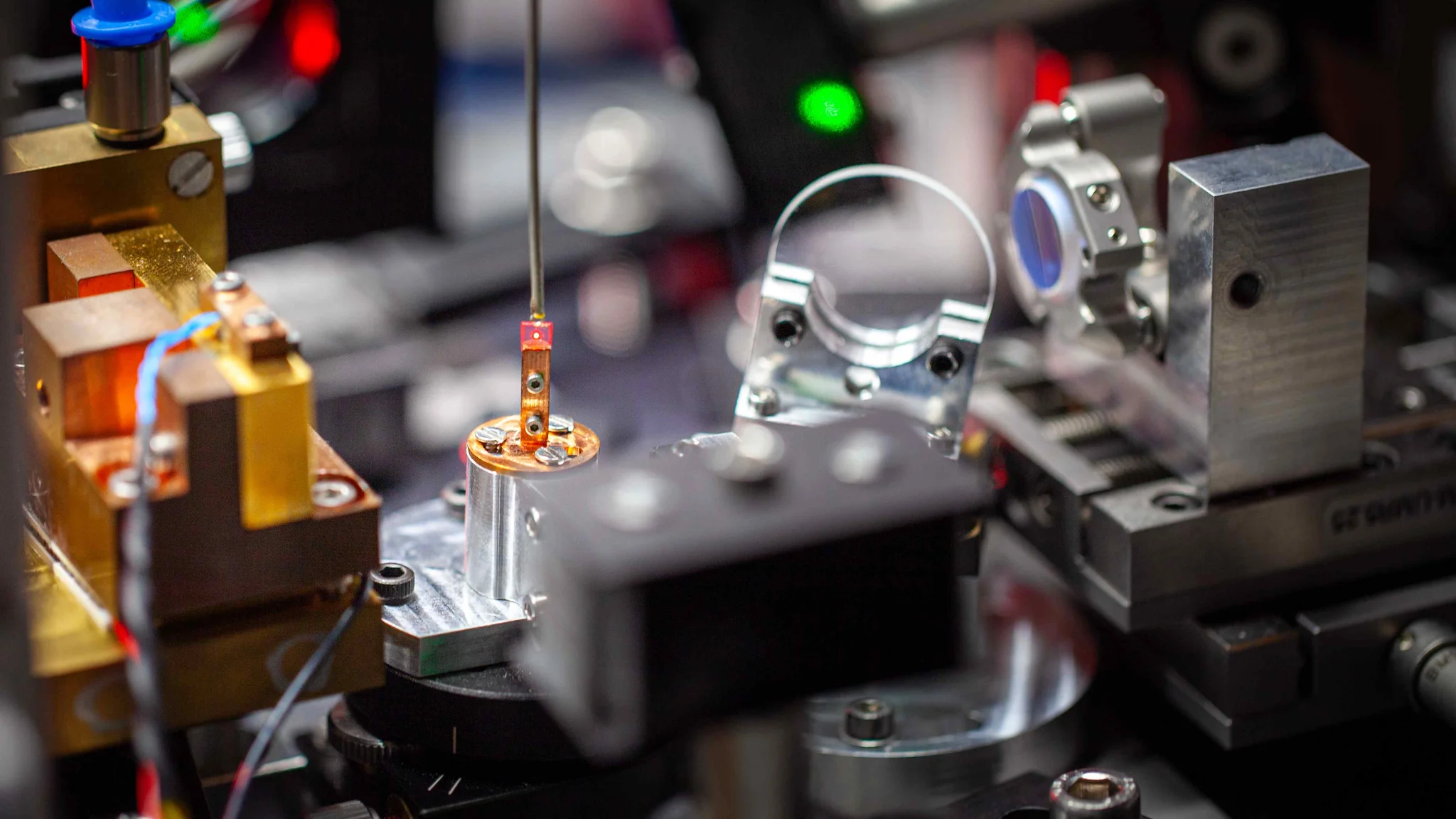
On 22 October, Jan Jeske’s team at the Fraunhofer Institute for Applied Solid State Physics (IAF) reported an experimental breakthrough in laser threshold magnetometry (LTM) in Nature Communications: placing an NV-centre-doped diamond in a 1,042 nm laser cavity as a magnetic-field-dependent loss channel and reading out the magnetic field via the laser signal itself, they achieved the first 100% optical contrast in NV magnetometry (versus a few percent for conventional fluorescence readout). Combined with a coherent laser readout signal of up to 50 mW, sensitivities below 400 fT/√Hz were reached for all three magnetic-field vector components; the sensitivity-limit-to-dynamic-range ratio improves by up to 590x over conventional fluorescence-based NV sensors and vapour-cell magnetometers, while keeping vector capability and an intrinsic dynamic range of several hundred microtesla. The paper is open access (CC BY 4.0), DOI 10.1038/s41467-026-78386-z.
01 / Putting diamond inside the laser: two-media laser-threshold magnetometry
Conventional NV magnetometers read out fluorescence: the intensity difference between spin states is only a few percent — low contrast, weak signal — locking in the sensitivity-versus-dynamic-range trade-off. Laser threshold magnetometry (LTM) inverts the idea: the NV diamond becomes a magnetic-field-dependent loss element inside the laser cavity. The external field changes NV spin-state populations via the Zeeman effect, altering absorption of the 1,042 nm cavity light and shifting the laser threshold.
The IAF team used a two-media design: a 1,042 nm membrane external-cavity surface-emitting laser (MECSEL) supplies the gain while the NV diamond supplies the field-dependent loss, both in one cavity. Measurements show the lasing threshold shifts from 1.53 W to 1.82 W under resonant microwaves; at the 1.82 W pump point, resonant microwaves switch off a laser output of more than 50 mW entirely — that is 100% optical contrast: the signal goes from on to off, not a few-percent fluorescence wobble.
02 / 100% contrast + 50 mW signal: where the 590x comes from
The paper’s three key quantitative results: first, ODMR (optically detected magnetic resonance) reached 100% contrast (97% at another operating point with a 16 mW baseline) — a first for NV magnetometry — which the team attributes to lower intrinsic diamond absorption and higher cavity finesse. Second, assuming photon shot noise dominates, sensitivity below 400 fT/√Hz holds for all three vector components, and the paper provides the first experimental demonstration that attainable sensitivity improves more than linearly as contrast approaches 100%. Third, the crucial sensitivity-limit-to-dynamic-range ratio improves by up to 590x over conventional fluorescence NV sensors and vapour-cell magnetometers, while keeping vector capability, an intrinsic dynamic range of several hundred microtesla, and room-temperature operation.
Notably, this road took a decade: Jan Jeske, now head of IAF’s Quantum Sensing Group, proposed the theoretical model for a magnetic-field-dependent laser system ten years ago; the team demonstrated magnetic-field-dependent light amplification in 2022, and has only now crossed the laser threshold with the full loop.
03 / JUYAO take
Direct applications remain distant — the authors themselves point to biomagnetic signals from heart and brain, GPS-free magnetic navigation, resource exploration and security anomaly detection. For the laser industry, it offers an elegant “laser as sensor” example: the laser cavity is not just a processing tool but a readout amplifier that boosts magnetic-field information to 100% contrast. Using the extreme nonlinearity near threshold as an amplifier is itself an inspiring idea.
Open access (CC BY 4.0) means the full text and figures can be legally cited and reused — first-hand material for any quantum-sensing or precision-metrology coverage. What to watch next: whether the 50 mW-class laser readout can be compacted into a device, and how much of the 400 fT/√Hz survives in real noise environments rather than under the shot-noise assumption.
PRIMARY REFERENCES & LINKS
- Original paper: Laser-enhanced quantum sensing boosts sensitivity and dynamic range
Full text read and verified; DOI verified via Crossref
Open source link ↗ - phys.org report: Diamond laser system achieves 100% optical contrast in magnetic-field readout
Cover image carried here; image source is Fraunhofer IAF
Open source link ↗