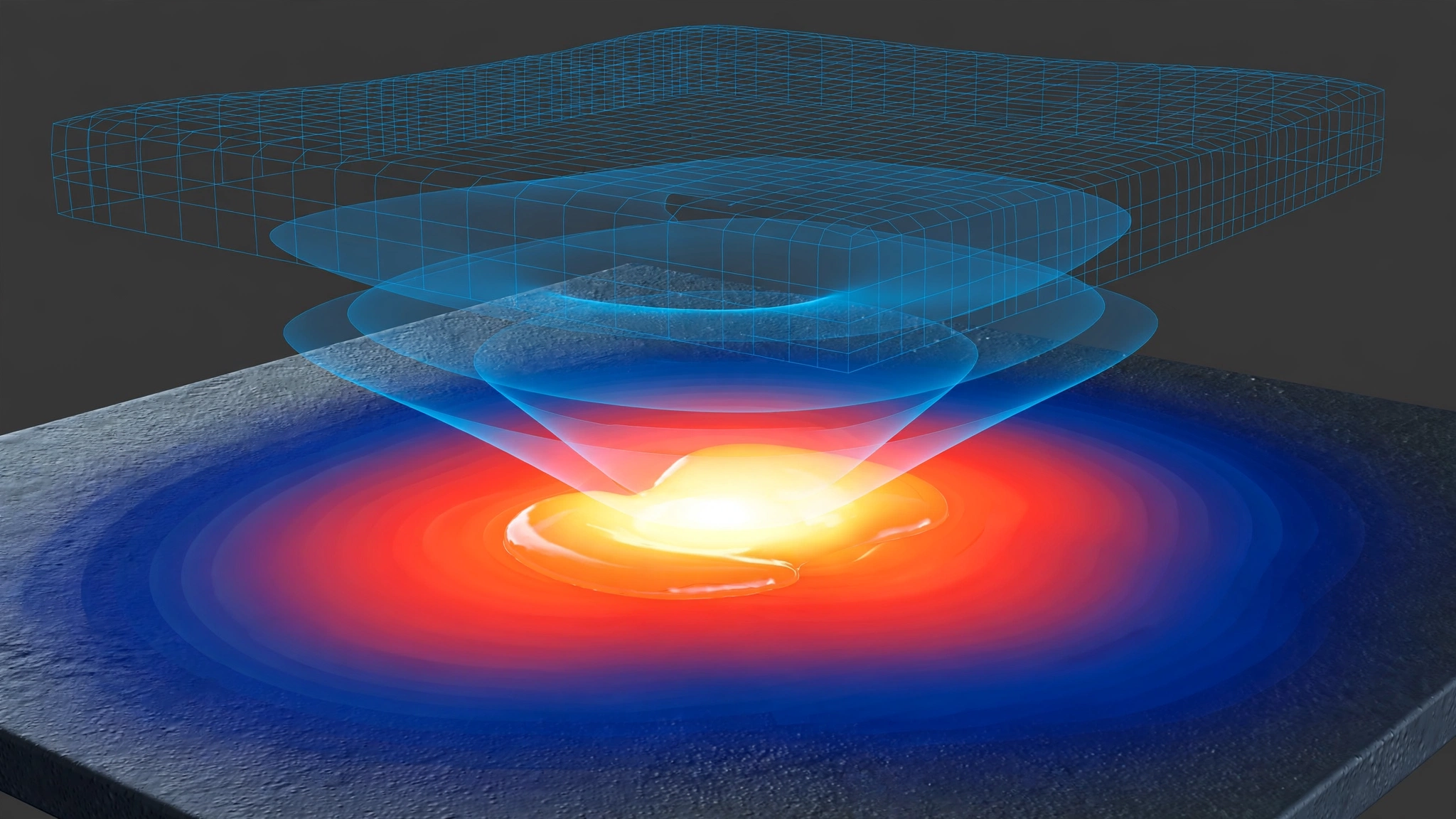
An open-access study in Communications Materials combines high-speed infrared imaging with transient 3D multiphysics modelling to analyze subsurface melt-pool temperatures and solidification conditions, verified by material characterisation.
01 / Experimental observation and 3D modelling
High-speed infrared imaging captures transient surface thermal behaviour, but it cannot directly reveal the full three-dimensional temperature evolution inside the melt pool and at the solid–liquid interface. The team converts observations into model inputs and uses transient 3D simulation to reconstruct the subsurface field.
The resulting solidification velocities and cooling rates are used to predict changes in microstructure size and orientation, which the authors compare with scanning electron microscopy and electron backscatter diffraction maps.
02 / Connecting process data and mechanisms
Recording only power and speed often leaves processing variances across environments or batches unexplained. By linking sensor observations, physical modelling, and material characterisation, the study provides a reference architecture for traceable process analysis.
Maintaining structured relationships among raw observations, machine states, process parameters, model versions, and measured outcomes helps improve process interpretability.
03 / Implications for laser software architecture
For laser software systems, structured coupon records—including material properties, focal length, power, speed, path strategies, and evaluation scores—help evolve from static presets toward systematic process knowledge.
Coordinating software, hardware logging, and material testing remains a core technical focus for JUYAO.
PRIMARY REFERENCES & LINKS
- Coupled infrared imaging and multiphysics modeling reconstruct three-dimensional solidification dynamics during metal laser melting
Open-access primary paper used to verify the material system, measurement and modelling method, validation path, and limits of the result.
Open source link ↗